Getting Around Toruń
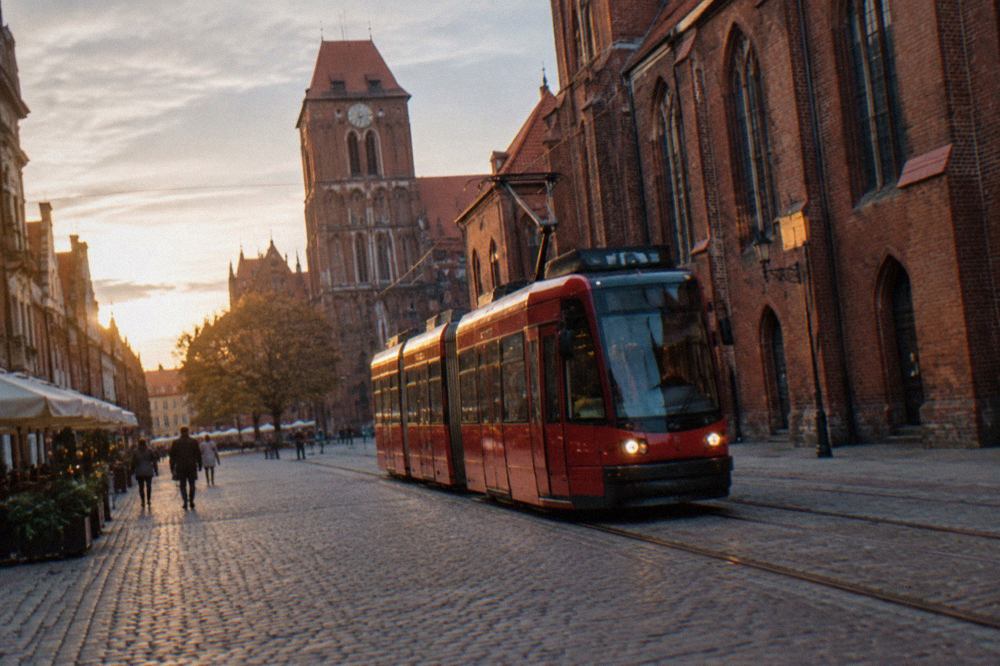
Toruń's Old Town is compact enough to cross on foot, and the MZK network of trams and buses covers the rest of the city with tickets from 4.60 zl. Here is what the published fares, stations and parking zones mean for a visit.
Short answer
Toruń's medieval centre is walkable end to end, so most visitors use public transport only to reach it. The MZK network sells a 60-minute ticket for 5.00 zl on paper or 4.60 zl on a phone, Toruń Miasto is the station 1.4 km from Rynek Staromiejski, and Old Town parking starts at 7.30 zl for the first hour in the Srodmiejska zone.
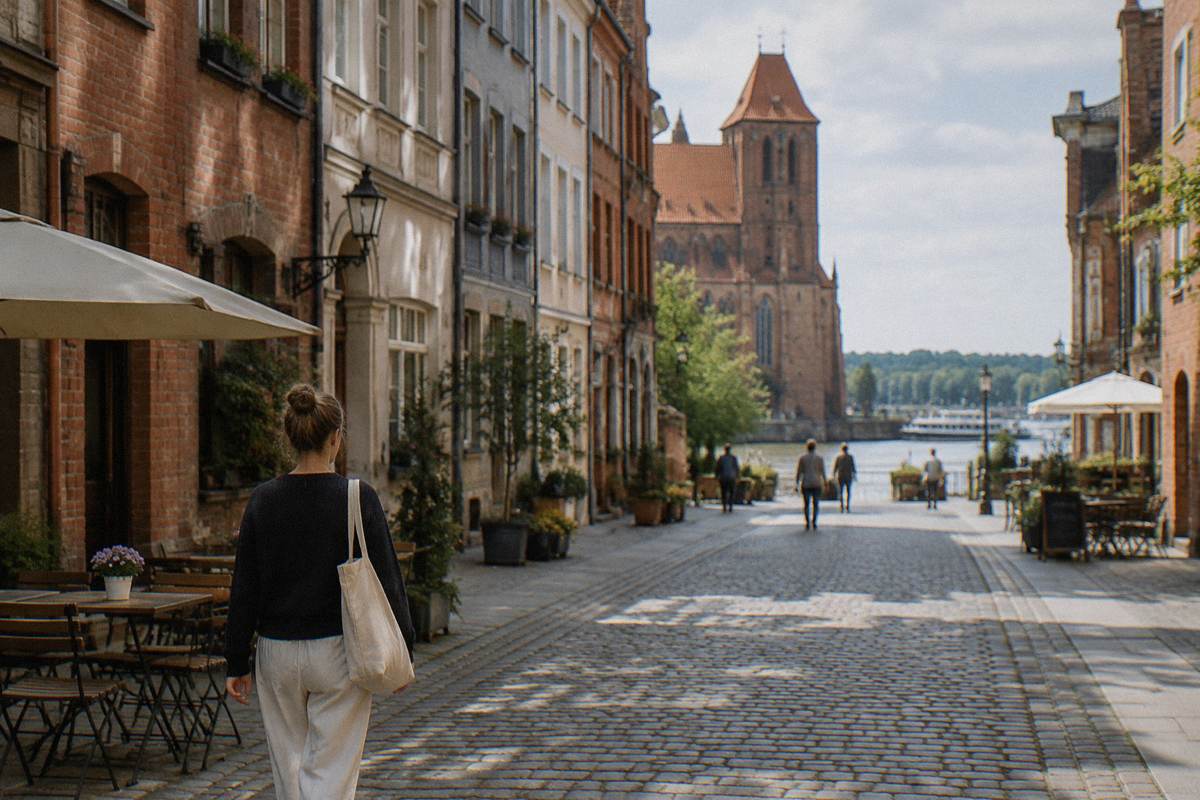
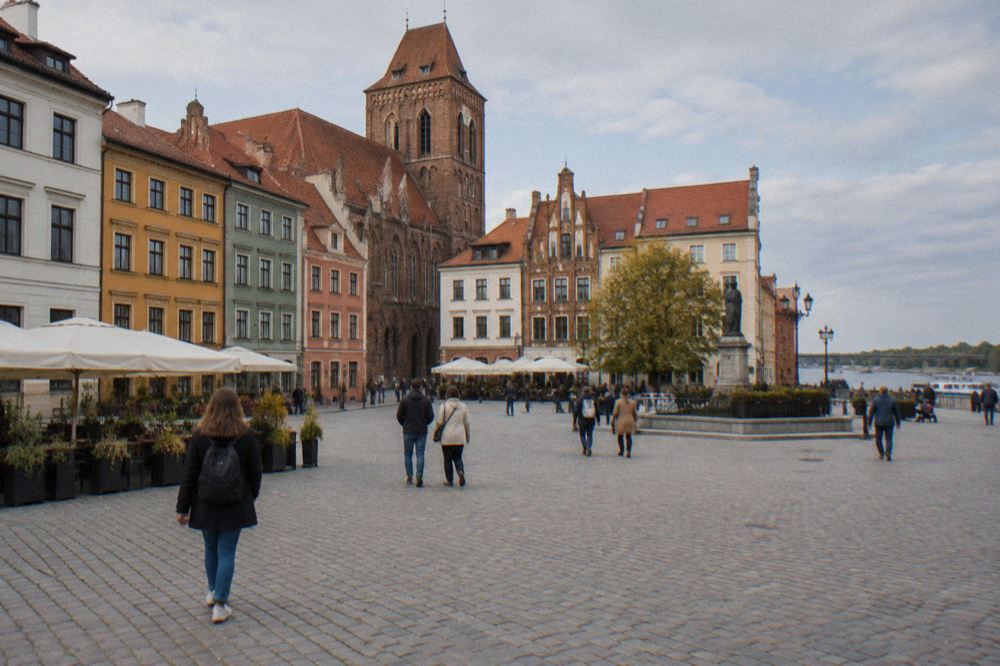
Toruń's Old Town sits on the right bank of the Vistula, ringed by its medieval walls and inscribed on the UNESCO list in 1997 as the Medieval Town of Toruń. Everything inside that ring, the Rynek Staromiejski, the castle ruins, the Copernicus House, lies within a short walk of everything else, which is why this page treats walking as the first form of transport and the tram and bus network as the way to reach the centre from the stations and the farther districts. The city had 192,784 residents on 31 December 2025, and the MZK network that serves them is the same one a visitor uses.
Do You Even Need Transport Inside Toruń?
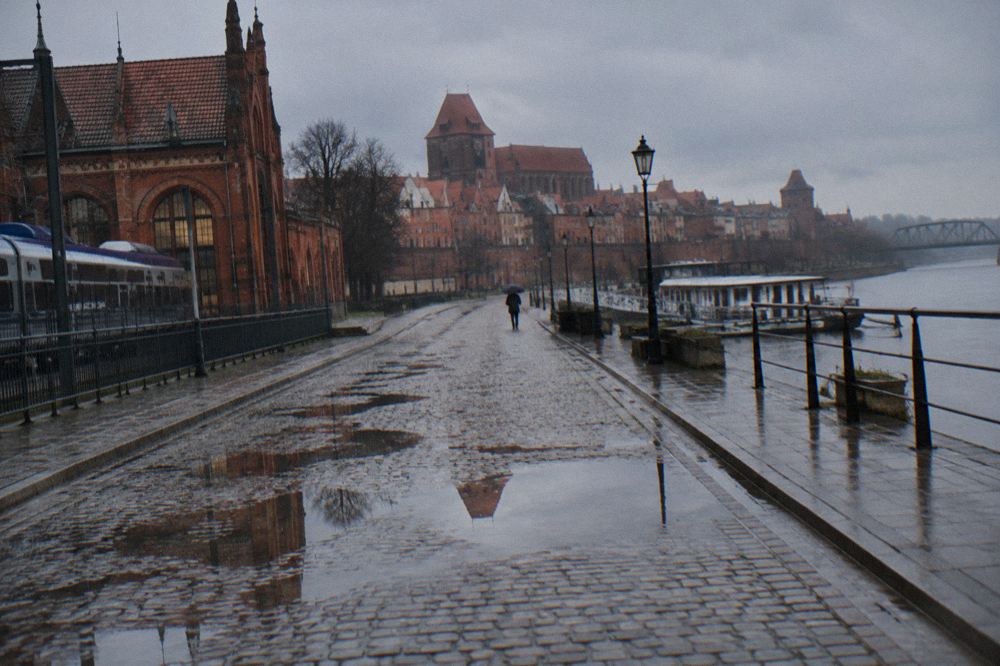
No, not for the medieval centre itself: the Old Town and the New Town, together with the Teutonic Castle ruins and the defensive walls that ring them, form one UNESCO property crossed entirely on foot. Toruń Miasto station is 1.4 km from Rynek Staromiejski. Toruń Główny is on the far bank at 2.3 km, or 2.8 km by road.
Those two distances decide most arrival plans. A traveller stepping off at Toruń Miasto can reach the heart of the Old Town on foot with a single bag. A traveller arriving at Toruń Główny crosses the Vistula first, and the bridge crossing is part of the walk rather than a detour around it. The Toruń train stations guide covers both stations in detail.
For orientation on that first walk, the self-guided walking route in the medieval town page maps the UNESCO property's three elements, the castle ruins, the Old Town and the New Town, so the walk from either station can be routed past them from the start. Anyone who prefers a guide at the outset can join the Medieval Town Walking Tour, which covers the same streets; the tour's own page carries the detail, and the card further down this article shows it.
Like the idea of a route already mapped for you. Book a self-guided Old Town tour here.
Beyond the medieval ring, distances grow. The planetarium, the zoo and the ethnographic museum sit outside the walls, and that is where the MZK network earns its ticket price.
What Tickets Does MZK City Transport Sell, And How Do You Pay?
MZK tickets come in paper and mobile versions, with the mobile or city-card price always lower: a 60-minute ticket costs 5.00 zl on paper, or 4.60 zl from a phone or the city card, and the reduced paper fare is 2.50 zl. The 24-hour ticket is 16.00 zl on paper or 15.00 zl on mobile and the city card, and a weekly ticket runs 50.00 zl on paper or 47.00 zl electronically.
The fare table the operator publishes:
| Ticket | Paper | Mobile or city card | Reduced (paper) |
|---|---|---|---|
| 60 minutes | 5.00 zl | 4.60 zl | 2.50 zl |
| 90 minutes | 8.00 zl | 7.60 zl | 4.00 zl |
| 24 hours | 16.00 zl | 15.00 zl | |
| Weekend (1 to 2 adults, day of validation and next day) | 18.00 zl | 17.00 zl | |
| Weekly | 50.00 zl | 47.00 zl |
Two of these tickets answer specific visitor patterns. The weekend ticket carries one or two adults on the day it is validated and the following day, which suits a two-night Saturday stay better than two separate 24-hour tickets. The weekly ticket matters only for a stay of a full week, where the arithmetic of the fare table favours it over seven daily purchases.
The answer to "How do you pay for public transport in Poland?" as it applies in Toruń: the mobile channel is the cheapest single-ticket option the operator publishes, priced below the paper equivalent for every ticket type in the table above, and the city card matches it. Cards are accepted "virtually everywhere" in shops in Poland, in the Polish Tourism Organisation's wording, so the phone-based purchase does not require carrying cash for it.
For a first visit built around the medieval centre, though, none of this may be needed on day one. The distances from both stations are walkable, and the one day in Toruń itinerary pages place the sights within the same walkable ring.
Which Station Should You Arrive At, And How Long Do The Trains Take?
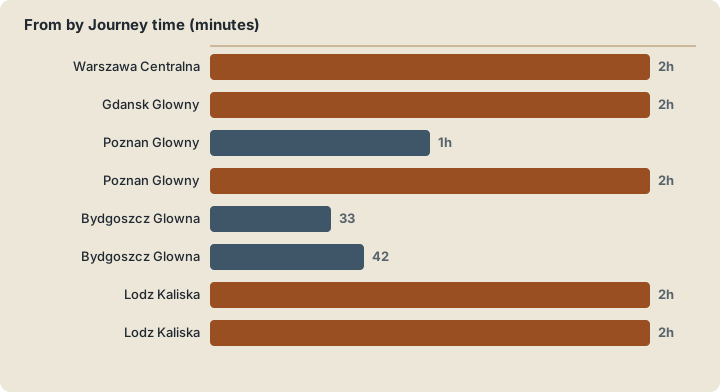
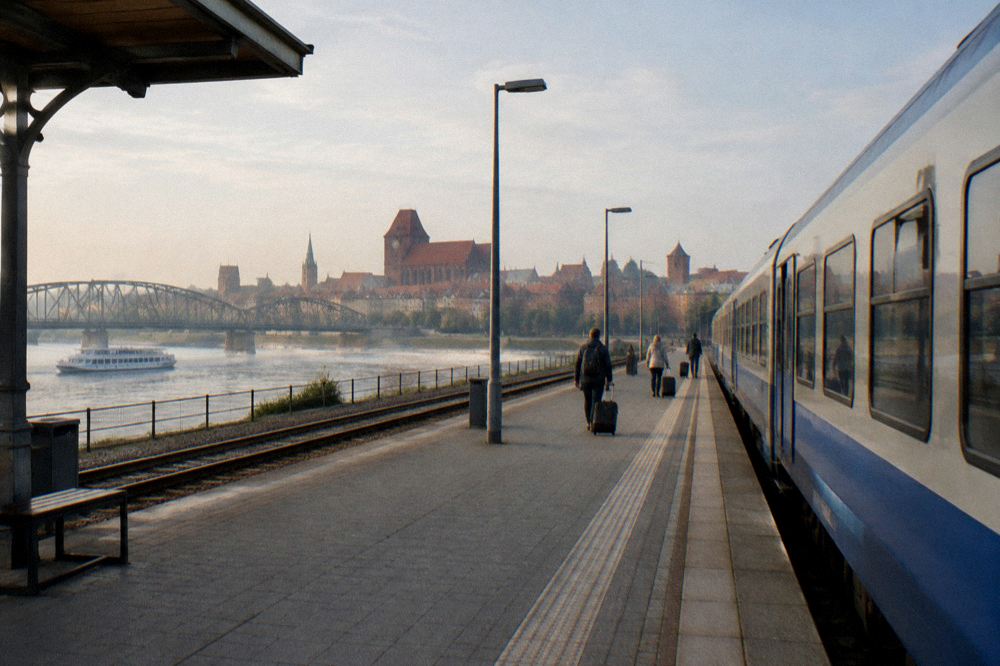
Arrive at Toruń Miasto if the destination is the Old Town: it is the right-bank station, 1.4 km and roughly 18 minutes on foot from Rynek Staromiejski. Toruń Główny, on the left bank, is 2.3 km and about 30 minutes on foot. Direct PKP Intercity trains from Warszawa Centralna take about 2 hours to 2 hours 17 minutes, from Gdansk Glowny about 2 hours 17 minutes to 2 hours 25 minutes, and from Poznan Glowny about 1 hour 24 minutes to 1 hour 29 minutes.
The rail picture in full, exactly as the timetables give it:
| From | Direct service | Journey time |
|---|---|---|
| Warszawa Centralna | PKP Intercity | about 2 hours to 2 hours 17 minutes |
| Gdansk Glowny | PKP Intercity | about 2 hours 17 minutes to 2 hours 25 minutes |
| Poznan Glowny | PKP Intercity | about 1 hour 24 minutes to 1 hour 29 minutes |
| Poznan Glowny | Polregio | about 2 hours 7 minutes to 2 hours 9 minutes |
| Bydgoszcz Glowna | PKP Intercity | about 33 minutes to 36 minutes |
| Bydgoszcz Glowna | Polregio | about 42 minutes to 46 minutes |
| Lodz Kaliska | PKP Intercity | about 2 hours 4 minutes to 2 hours 17 minutes |
| Lodz Kaliska | Polregio | about 2 hours 47 minutes to 2 hours 49 minutes |
Bydgoszcz's about 33 to 36 minutes by direct PKP Intercity train is the shortest link in the table, which shapes the Bydgoszcz to Toruń route as an easy pairing. The Warsaw to Toruń and Gdańsk to Toruń pages unpack the two longer corridors, each also served by an organised day-trip option listed on the day trip from Warsaw and day trip from Gdańsk pages.
One forward-looking point from the infrastructure record: PKP PLK opened a tender, announced on 25 and 26 September 2026, to rebuild both Toruń Miasto and Toruń Wschodni on line 353, with new platforms and underpasses, and completion planned for 2029. No works stand on site yet, so nothing in the table above changes for a visit planned now. The full station detail sits on the how to get to Toruń page.
For anyone whose train arrives outside walking-friendly hours or with heavy luggage, the three walks below compare the formats that remove the orientation problem entirely.
Each of the three works for a different party size, and all three cover the same streets the station walks deliver you into. When the choice is made, the box below settles the practical question of booking terms.
Where Can You Park Near The Old Town, And What Does The First Hour Cost?
The paid parking zone around the centre has three sub-zones, and the first hour costs 7.30 zl in Srodmiejska, the zone ringing the Old Town, 4.00 zl in zone A and 1.80 zl in zone B. Charging runs Monday to Friday 8:00-18:00 across the zones, and in Srodmiejska it also runs Saturday 8:00-18:00, a rule in force since 1 June 2021. Driving without a ticket draws a 92 zl penalty, rising to 230 zl after 5 days.
| Sub-zone | First hour | Charging hours |
|---|---|---|
| Srodmiejska (SSPP, the Old Town ring) | 7.30 zl | Monday to Friday 8:00-18:00 and Saturday 8:00-18:00 |
| Zone A | 4.00 zl | Monday to Friday 8:00-18:00 |
| Zone B | 1.80 zl | Monday to Friday 8:00-18:00 |
The practical consequence of the Saturday rule is that a weekend arrival by car pays for parking in the closest zone on Saturdays but not Sundays, while zones A and B charge on neither weekend day. Parking in zone B and walking in, or parking outside the paid zone entirely and riding MZK the last stretch with a 4.60 zl mobile ticket, are both cheaper than the Srodmiejska first hour. Other pages covering the same trip are gathered on Toruń Travel Guide.
For visitors arriving with luggage and hours to spare before check-in, a left-luggage booking in the centre removes the bag from the parking arithmetic altogether. Travellers planning to move on to the surrounding region can also compare car hire for Toruń before committing to the paid zones.
How Far Is Toruń From The Nearest Airports?
Bydgoszcz Airport (BZG) is the closest at 55 km by road, followed by Gdansk Lech Walesa (GDN) at 173 km, Warsaw Modlin (WMI) at 177 km and Lodz (LCJ) at 186 km. Poznan Lawica (POZ) is 200 km by road and Warsaw Chopin (WAW) 260 km. Each distance is by road, so the rail times in the table above, not the airport road distances, are the figure that governs a train-based transfer from the cities those airports serve.
| Airport | Code | Distance by road |
|---|---|---|
| Bydgoszcz | BZG | 55 km |
| Gdansk Lech Walesa | GDN | 173 km |
| Warsaw Modlin | WMI | 177 km |
| Lodz | LCJ | 186 km |
| Poznan Lawica | POZ | 200 km |
| Warsaw Chopin | WAW | 260 km |
Bydgoszcz's position at 55 km makes it the airport that pairs naturally with the roughly 33 to 36 minute direct rail link from Bydgoszcz Glowna, and the Toruń airport page works through the transfer options. For arrivals through Warsaw or Gdańsk, the rail table in the station section above, or the dedicated Warsaw and Gdańsk day-trip pages, carry the planning detail.
Arrivals with a full first morning ahead of them can hand that morning to the Budget Guided Sightseeing Walk instead of a self-planned route.
Can A Guided Walk Replace Getting Oriented Alone?
For orientation on the first day, a guided walk of the medieval streets is the direct substitute for working out the layout alone: the Medieval Town Walking Tour is the site's featured option for this page, the Budget Guided Sightseeing Walk is the lower-priced alternative, and the Budget Private Medieval Walk is the private version. Each exists for a different party size and pace, and all three cover the same walkable UNESCO ring that the stations deliver you to on foot.
The choice between them is a choice of format rather than of route. The Medieval Town Walking Tour suits a visitor who wants the standard guided format. The Budget Guided Sightseeing Walk is the one to check when price is the constraint. The Budget Private Medieval Walk fits families or small groups who want the walk to themselves. Cards for all three appear in the comparison band in this article.
Once oriented, the rest of the city opens with the ticket table above. The Toruń planetarium and the other sights beyond the walls are reachable on the same MZK fares, and the timing of a visit can be matched against the best time to visit Toruń page, which carries the climate normals month by month.
Families and small groups weighing the private format can look at the Budget Private Medieval Walk on its own card below.
How Do Arrivals By Long-Distance Bus Work Out?
Long-distance FlixBus services stop at the Toruń bus station, Dworzec Autobusowy at ul. Dabrowskiego 8/24, and at a second stop on ul. Broniewskiego, which uses the city bus stops on both sides of the road. Both stops sit on the network the MZK ticket table covers, so the same 4.60 zl mobile ticket that serves a tram ride from a station serves the ride from the bus stop toward the Old Town.
The bus station address places it in the same districts the parking zones cover, which matters for a traveller connecting onward: the walk from the Old Town to Dworzec Autobusowy crosses paid parking territory, and the MZK options in the ticket table are the alternative to that walk with luggage. The Broniewskiego stop's use of ordinary city bus stops on both sides of the road means boarding direction is fixed by which side of the road the stop stands on, not by a separate coach terminal layout.
For seasonal planning around arrival, the Toruń Christmas market page notes that the stalls trade daily from 20 November 2026 to 10 January 2027, and the Toruń events and Camerimage pages track the festival calendar that shifts demand on transport and parking alike.
What Does A Car-Free Day In Toruń Actually Look Like?
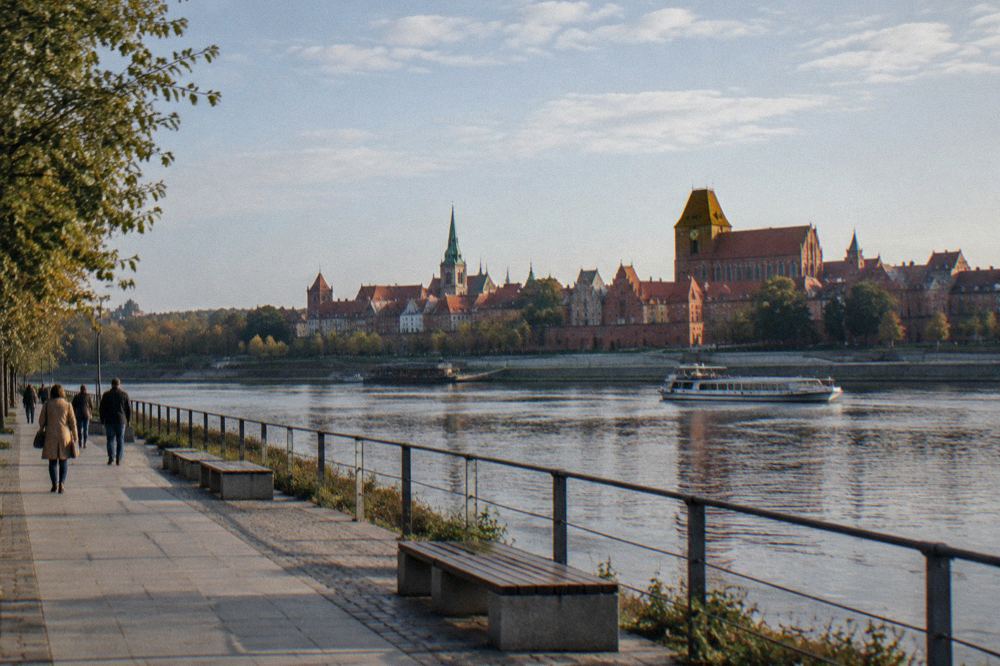
A car-free day starts on foot at either station, Toruń Miasto at 1.4 km or Toruń Główny at 2.3 km from Rynek Staromiejski, spends the morning inside the UNESCO ring where no ticket is needed to move, and uses one 4.60 zl mobile MZK ticket only for an outward sight beyond the walls. Parking never enters the day, and the weekend ticket at 17.00 zl on mobile covers two adults across two days if a second travelling day is planned.
The sequence writes itself from the facts on this page. Walk in from the station. Spend the daylight in the medieval ring, whose three UNESCO elements, the castle ruins, the Old Town and the New Town, all connect on foot. Buy the single mobile ticket only when a sight outside the walls, such as the zoo or the ethnographic museum, is on the plan. For the evenings, the Toruń nightlife question and the cost picture on the is Toruń expensive page frame what a day without a car spends on everything else.
A final option for the first morning is the featured walk of this page, shown on its own card below.
Whichever of the three formats fits, the operator's live listing carries the current terms, and the comparison band gathers all three side by side once more before the questions below.
Common Questions About Getting Around Toruń
How do you pay for public transport in Poland?
In Toruń, the MZK operator sells every ticket in both a paper version and a mobile or city-card version, and the electronic versions are cheaper for each ticket length: 4.60 zl against 5.00 zl for 60 minutes, 15.00 zl against 16.00 zl for 24 hours. Cards are accepted "virtually everywhere" in Polish shops, in the Polish Tourism Organisation's wording, so paying by phone or card is the standard route.
Which train station is closest to Toruń's Old Town?
Toruń Miasto, on the right bank of the Vistula, is 1.4 km and about 18 minutes on foot from Rynek Staromiejski. Toruń Główny sits on the far bank at 2.3 km, about 30 minutes on foot or 2.8 km by road.
How much does parking cost in Toruń's Old Town?
The Srodmiejska zone ringing the Old Town charges 7.30 zl for the first hour, zone A charges 4.00 zl and zone B 1.80 zl. Charging runs Monday to Friday 8:00-18:00, and in the Srodmiejska zone also Saturday 8:00-18:00. The penalty for driving without a ticket is 92 zl, rising to 230 zl after 5 days.
What is the nearest airport to Toruń?
Bydgoszcz Airport (BZG) at 55 km by road. The next nearest are Gdansk Lech Walesa at 173 km, Warsaw Modlin at 177 km, Lodz at 186 km, Poznan Lawica at 200 km and Warsaw Chopin at 260 km.
Is Toruń walkable without using public transport?
The Old Town and the New Town, together with the Teutonic Castle ruins and the defensive walls, form one UNESCO property crossed entirely on foot, and both railway stations lie within about 18 and about 30 minutes' walk of Rynek Staromiejski. MZK tickets matter only for sights beyond the walls.
The published fares, distances and timetables all point one way: arrive on foot through either station, keep the car outside the Srodmiejska zone, and buy an MZK ticket only when the day reaches past the medieval walls. That is the whole of getting around Toruń, and it costs less than the first hour of Old Town parking.