Was Copernicus Polish Or German?
Copernicus was born in Toruń in 1473 to a German-speaking merchant family in Royal Prussia, a region of the Kingdom of Poland, and spent his church career serving the Polish crown.
Was Copernicus Polish or German? It is the question every visitor to Toruń asks in front of the astronomer's statue on Rynek Staromiejski, and the honest answer is that both labels fit one man. Copernicus was born in Toruń on 19 February 1473, the child of a German-speaking merchant family, in Royal Prussia, a semi-autonomous region of the Kingdom of Poland. The Stanford Encyclopedia of Philosophy summarises the position in one line: "Thus the child of a German family was a subject of the Polish crown." Encyclopaedia Britannica calls him a "Polish astronomer" and gives his birthplace as "Torun, Royal Prussia, Poland".
The debate is not a fringe quarrel. Wikipedia opens its own section on the question with the words: "There has been discussion of Copernicus's nationality and of whether it is meaningful to ascribe to him a nationality in the modern sense." A man born in 1473 belonged to a kingdom, a city and a family, not to a nation-state. For a fuller account of the city that raised him, see where Copernicus was born.
Was Copernicus Polish Or German?
He was both, and neither label alone is wrong. Copernicus was born in Toruń on 19 February 1473, the youngest of four children of Nicolaus Copernicus senior, a well-to-do merchant who had moved to Toruń from Krakow, and Barbara Watzenrode, daughter of a leading Toruń merchant family. The family spoke German. The city, under the Second Peace of Thorn of 1466, stood inside the Kingdom of Poland as a free city of the Polish crown.
Fighting between the Teutonic Order and Poland ended in 1466, West Prussia including Toruń was ceded to Poland, and Toruń was declared a free city of the Polish kingdom, as the Stanford Encyclopedia of Philosophy records. So the child who arrived seven years later entered a world where the political frame was Polish and the household tongue was German. Britannica's label, "Polish astronomer", reflects the political frame and the trajectory of his career. The German claim reflects his family and his mother tongue. Both rest on documented facts, and the facts sit side by side rather than in competition.
His father died in 1483, when Copernicus was about ten. His maternal uncle Lucas Watzenrode (1447 to 1512), bishop of Warmia from 1489, took charge of his education and church career, and in 1495 Watzenrode arranged his election as a canon of the Warmia cathedral chapter at Frombork (Frauenburg in German). The career that followed ran inside the Polish church and, at its most dangerous moment, inside Poland's war effort.
What Language Did Copernicus Speak?
German was his mother tongue, Latin was his working language, and whether he knew Polish is disputed. He was born and raised in Royal Prussia, a semi-autonomous and multilingual region of the Kingdom of Poland, the child of German-speaking parents. His scientific work is in Latin. A report on coinage that he presented to the Prussian Diet at Grudziadz in 1522 was written in German. On Polish, the scholars disagree.
The dispute over his Polish is real and unresolved, and both sides are worth quoting. Norman Davies writes that "there is ample evidence that he knew the Polish language". Edward Rosen points to his inconsistent spelling of Polish tenants' names as a sign he was not fluent. Neither claim settles the matter, and a visitor who repeats only one of them is telling half the story. What is documented is the multilingual world he moved through: a German-speaking household in a Polish kingdom, a Latin university culture, and a German-language administrative report delivered to a Prussian assembly.
For anyone who wants to see the streets where this multilingual family lived, the Copernicus House and the surrounding medieval Old Town carry the story in brick and stone, and the Copernicus trail through Toruń connects the sites.
How Did Copernicus Sign His Own Name?
He signed differently in different cities, and the signatures map his world precisely. In Torun his name was recorded as Niclas Koppernigk. At Krakow he signed in Latin as "Nicolaus Nicolai de Torunia". At Bologna in 1496 he registered with the German nation of students (Natio Germanica) as "Nicolaus Kopperlingk de Thorn". No single signature carries a national flag.
Each name belongs to the institution that recorded it. The Torun record is a burgher's son in a Hanseatic trading city. The Krakow signature is a student writing the Latin of the university. The Bologna registration places him among the German nation of students, a standard administrative category of medieval universities rather than a statement of allegiance. The one constant across all three is the city he names as his own: Torunia, Thorn, Toruń.
| Where | How he was recorded | Context |
|---|---|---|
| Toruń | Niclas Koppernigk | His name in his home city |
| Kraków | "Nicolaus Nicolai de Torunia" | Latin signature at the university |
| Bologna, 1496 | "Nicolaus Kopperlingk de Thorn" | Registered with the German nation of students (Natio Germanica) |
The table shows why the nationality argument never ends: the same man appears in German, Latin and, in his city's own records, in the form a Toruń burgher family used. For the city itself, what Toruń is famous for runs well beyond one astronomer, but the Copernicus sites anchor most visits.
Did Copernicus Fight For Poland?
Yes, in the only war of his lifetime he served the Polish crown. During the Polish-Teutonic War of 1519 to 1521, when the Teutonic Knights besieged Allenstein (Olsztyn), Copernicus directed the defence of the town and of Warmia by royal Polish forces. He lived at Olsztyn Castle from 1516 to 1521.
This is the fact that gives the Polish claim its strongest footing. A canon of the Warmia chapter, holding office under a Polish church administration headed by his uncle, organised a military defence for the Polish side against the Teutonic Order, the very power his home city had been ceded away from in 1466. His adult life was spent inside the political structures of the Kingdom of Poland, and at the moment those structures were under arms, he took a command. Anyone weighing the two national labels should put this service on the scale next to his German mother tongue. The rest of the planning pages sit on Toruń Travel Guide.
Can You Visit The Copernicus House In Toruń?
Yes, the Copernicus House at ul. Kopernika 15/17 is a museum of Copernicus and of medieval burgher life in two Gothic townhouses, and an adult ticket costs 33 zl, reduced 28 zl, with an audioguide at 15 zl. It opens Tuesday to Sunday, 10:00-18:00 from 1 May to 30 September and 10:00-16:00 from 1 October to 30 April, closed Monday, and permanent exhibitions are free on Thursday.
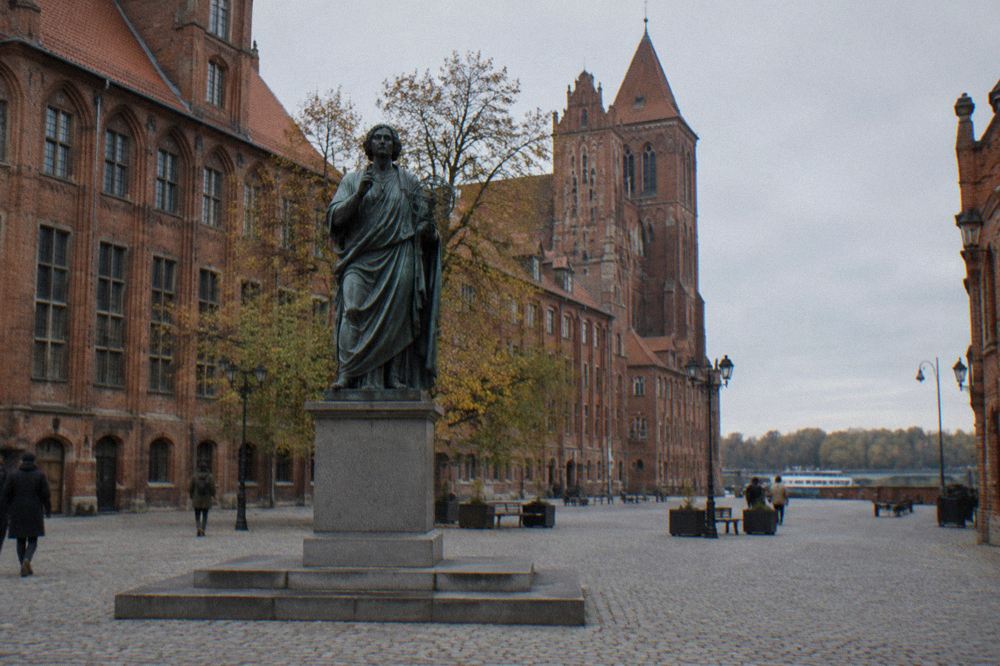
No. 15 is the traditional birthplace, and no document proves the exact house; what is not disputed is his birth in Toruń on 19 February 1473. The museum presents the two Gothic houses as the reputed family home, and that word "reputed" is the accurate one to use in front of the building. The Copernicus monument, unveiled on 25 October 1853 on Rynek Staromiejski and designed by Christian Friedrich Tieck, stands a short distance away in the Old Town square.
| Copernicus House | Detail |
|---|---|
| Address | ul. Kopernika 15/17 |
| Adult ticket | 33 zl (reduced 28 zl) |
| Audioguide | 15 zl |
| Hours, 1 May to 30 September | Tuesday to Sunday 10:00-18:00 |
| Hours, 1 October to 30 April | Tuesday to Sunday 10:00-16:00 |
| Free day | Thursday, permanent exhibitions |
For a guided route through these sites, the Private Copernicus Trail Walk is the option to look at, and the operator's live listing carries current availability: Check availability. The Self-Guided App Walk suits anyone who prefers to move at their own pace, and the Medieval Town Walking Tour covers the wider streetscape the family knew.
How Should A Visitor In Toruń Answer The Question?
Treat it as a question about 1473, not about modern borders. The documented facts are these: a German-speaking merchant family in a multilingual free city of the Polish kingdom, a Latin scientific career, a disputed command of Polish, and military service to the Polish crown in the war of 1519 to 1521. Britannica calls him a Polish astronomer; the Stanford Encyclopedia calls him the child of a German family under the Polish crown.
Both statements are true at once, which is why the argument has never produced a winner. What a visitor can do with the question is walk it: the family houses on ul. Kopernika, the monument on the square, and the medieval streets of the Old Town all belong to the same documented life. Whether Toruń itself deserves your time has its own answer at is Toruń worth visiting, and a one-day plan exists at one day in Toruń.
Common Questions About Copernicus In Toruń
Was Copernicus Polish or German?
Both labels describe him. He was born in Toruń on 19 February 1473 to a German-speaking merchant family, in Royal Prussia, a region of the Kingdom of Poland, and during the Polish-Teutonic War of 1519 to 1521 he directed the defence of Allenstein (Olsztyn) for royal Polish forces.
Is Copernicus Polish or German?
The Stanford Encyclopedia of Philosophy writes that "the child of a German family was a subject of the Polish crown", and Encyclopaedia Britannica calls him a "Polish astronomer". Both rest on what is known of his life: a German mother tongue and years spent inside the Polish kingdom's political and church structures.
Was Nicolaus Copernicus German or Polish?
His parents were German-speaking, and at Bologna in 1496 he registered with the German nation of students as "Nicolaus Kopperlingk de Thorn". His career ran in the Polish church and state: a canon of Warmia from 1495 and a defender of Olsztyn for the Polish crown in the war of 1519 to 1521.
Did Copernicus speak Polish or German?
German was his mother tongue and Latin his working language. Whether he knew Polish is disputed: Norman Davies writes that "there is ample evidence that he knew the Polish language", while Edward Rosen points to his inconsistent spelling of Polish tenants' names as a sign he was not fluent.
What language did Copernicus speak?
He grew up speaking German in a multilingual region of the Kingdom of Poland, wrote his scientific work in Latin, and wrote a report on coinage presented to the Prussian Diet at Grudziadz in 1522 in German.
Can you visit the house where Copernicus was born?
The Copernicus House museum at ul. Kopernika 15/17 occupies two Gothic townhouses, and No. 15 is the traditional birthplace, though no document proves the exact house. His birth in Toruń on 19 February 1473 is not disputed. An adult ticket costs 33 zl and permanent exhibitions are free on Thursday.
The record answers the question the same way from every angle: a German-speaking family, a Polish kingdom, a Latin career, and one city, Toruń, that he named as his own in every signature he left.